HKI Jul - Aug 2019
HKI Jul - Aug 2019

With a population of 1.4 billion, the Mainland market is one which all businesses would like to secure a share. However, foreign companies often struggle to adapt to its customs and tradition, thus hindering their development in it. A Hong Kong wine distributor told us that due to the significant cultural differences between Hong Kong and the Mainland, companies’ management must visit various provinces and cities in person to “touch base” and learn about the local business culture so as to overcome the hurdles. Meanwhile, other Hong Kong famous manufacturers have constantly modified their strategies to closely follow the mainland market trends and to make the features of their own products shine. According to a market research conducted by Hong Kong Trade Development Council (HKTDC), owing to the recent changes in the population structure in the Mainland and the rising spending power of the citizens there, Hong Kong businesses still enjoy advantages in some inland cities and certain high-end product markets. In the Focus Story of this issue, we interviewed several Hong Kong entrepreneurs engaging in various industries, and summarised their valuable experience regarding venturing into the Mainland market, in a bid to explore the future directions for domestic sales and market promotion.
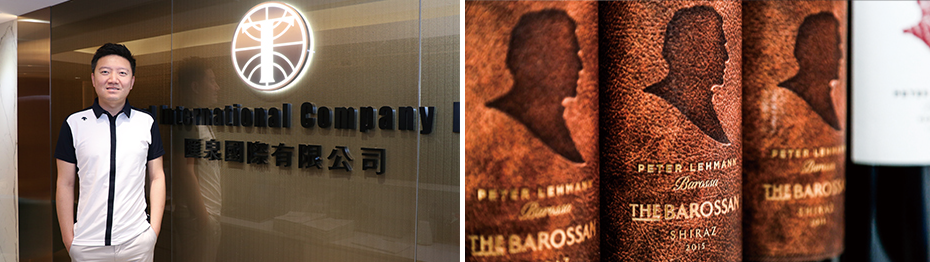
Telford - Skyrocketing Revenue amid Complex Mainland Market
“While many people see China as a gold mine and tell us that we can earn a lot if every person in the 1.4 billion population buys a bottle of wine from us, I would ask them to use their right mind to think again. The point is: Many people in China are farmers, and they would not buy our wine,” Telford Wine & Spirits (Shanghai) Limited Director Vincent Fong pointed out frankly. He added that many companies have had unrealistic expectations for the Mainland market. Yet, Telford’s mainland business has been growing. Ten years ago, the company’s turnover derived from its Mainland business equaled only to 5% of that derived from the Hong Kong business. Today, however, the two have balanced out with the former possibly outnumbering the latter in a short time. “You may think that I have already succeeded, but I would say it is just a start,” he expressed.
In 2009, Mr Fong joined Telford International Company Limited, which was run by his family, to restructure the company’s international red wine, spirit and beverage business in the Mainland. He said that the language differences between the two places as well as the Mainland localism have posed tremendous challenges to Hong Kong businesses operating there. Therefore, learning about how to adapt to different business cultures is a big lesson. “People living in the northeastern part of China put friendship on the top of their priority list. If they feel your sincerity, they don’t mind earning a bit less from the partnership. While for the people in Shanghai, they have a business mindset and often put emphasis on profit and cost. As for the people residing in the southern part of China, they rather focus on short-term benefits, instead of long-term partnership,” Mr Fong shared. In order to grasp the customers’ taste preferences and the market demand, he has insisted to personally visit various regions in the mainland despite holding a management position. He gave us an example, saying that for a sweet orange wine of Rémy Martin, while customers all around the world are used to mix it with other ingredients in cocktails, Xinjiang people, who have a sweet tooth, tend to drink it directly.
Commenting on the complexity of markets, he made such an analogy, “While entering the Chinese market resembles studying a doctoral course, running a business in Hong Kong is only like going to a nursery class.” As for the sales and promotion channels in the two places, Mr Fong mentioned that while Hong Kong only has several mainstream media outlets and several large-scale supermarket chains, in the Mainland, each region has their own local media outlets as well as their provincial and municipal supermarket chains, which would ask for a different share of distribution profits from the company. “Fundamentally, China is not only one market, but comprises of forty or fifty markets,” he noted.
Progress Step by Step to Secure Success
To sum up his experience for the past ten years, Mr Fong said that if businesses would like to make their ways to the mainland market, they must never be too aggressive and impatient. “Most foreign enterprises failed because they had too much faith in themselves, but they were in fact not ready to do so,” he told. On the contrary, when Mr Fong took over the family business in 2009, he launched multiple reforms to scale down the operation. For instance, he dismissed 70% of the mainland employees as they were untrustworthy; reduced the wine brands which the company distributed from 20 to two; and closed down the office in Chengdu to focus on the company’s development in Shanghai. Eventually, the company broke even at the end of the first year after implementing such measures, with enough turnover to cover the expenses of the company’s three offices in Shenzhen, Guangzhou and Beijing. Today, after a decade, Telford has grown stronger with its new team of over 200 people distributing more than 20 internationally renowned brands.
Mr Fong expressed, “We evaluated our capability at first. If we were not focused enough on our work, we might turn out to suffer from loss.”
Currently, wholesaling and retailing account for 80% and 20% of Telford’s mainland business respectively. Mr Fong mentioned that the company will put greater efforts in managing its retail outlets to increase the distribution profits. Seeing the drastic changes occurred in China, he frankly said that he still has things to learn. “In the past ten years, I have been cheated by many people and paid quite a lot of ‘tuition fees’. As a matter of fact, I was still cheated and lost several hundred thousand dollars just a few days ago. However, I will not let the same mistake happen twice,” he concluded.

Economist: Third and Fourth-tier cities as Desirable Entry Points for HK businesses
As compared with other markets, especially those in traditional European and American countries as well as emerging Southeast Asian countries, China’s domestic sales market has experienced the most rapid growth. In the past five years, the figures of China’s total retail sales of consumer goods have achieved a year-on-year growth of 10%. HKTDC Assistant Principal Economist (Greater China)
Alice Tsang pointed out that even though enterprises have exhibited diminishing investment desire, as a result of the China-US trade war, such effects have not yet been reflected on the figures of consumer market. She said, “Being prompted by national policies, domestic sales are still believed to be the driving force of China’s economic development.” As Ms Tsang analysed, Hong Kong businesses particularly possess development potential in certain markets and regions.
In her view, it is the most difficult for Hong Kong businesses to expand into the markets of those first and second-tier cities in the mainland. “Although the consumption levels of those places are high, as international brands have already entered into those markets earlier, competition there is intense,” she explained. Third and fourth-tier cities, on the contrary, are desirable entry points for Hong Kong businesses to venture into the mainland market. It is because the local spending power and total consumption volume there are close to those of the first and second-tier cities. Another reason is that those cities’ citizens are also more sensitive to prices. “As international brands have not made their ways to those local markets entirely, medium-sized brands usually perform better there,” she added. In addition, Hong Kong companies can also look out for cities in central China such as Zhengzhou as well as cities in the west like Chengdu and Chongqing.
Increasing Purchasing Power of New Generation
According to Ms Tsang’s analysis, mainland citizens’ purchasing power and consumption pattern are both affected by the local population structure. “As most families in the mainland still only have one child, their economic burdens are relatively light, and their consumption power is relatively high. For those who were born after 1970, many of them know foreign brands and products well. Therefore, they have the potential demand for such brands and products naturally,” she told. Ms Tsang pointed out that as the problem of aging population has been increasingly serious in the mainland, and as the seniors there have had greater demand for personal health monitoring, clothing and tourism products, there are actually plenty of business opportunities for Hong Kong businesses to grasp in terms consumer products and services tailored to the seniors in the Mainland.
While large enterprises with more resources are capable of launching short-term promotion in specific mainland cities, she particularly recommended small and medium-sized enterprises (SMEs) to make use of the support provided by HKTDC in this aspect. For instance, it would gather some Hong Kong businesses to stage roadshows in mainland cities, recruit Hong Kong businesses to join large-scale commercial and trade fairs held in the mainland inside the “Hong Kong Pavilion” as well as organise mainland tours. Moreover, HKTDC has also introduced commercial and trade matching services for Hong Kong companies. It has also provided them with free consultation services regarding China’s commercial conditions. For these services, two officials coming from the mainland commerce department would answer enterprises’ questions, assisting SMEs in getting to know and exploring the mainland market with a relatively small amount of resources.
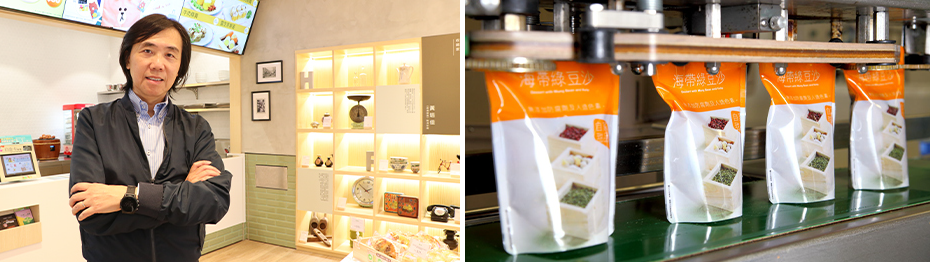
Hung Fok Tong - Focus on Wholesale To Meet Changing Market Needs
As the business environment in the mainland is complex and ever-changing, in order to capture opportunities, entrepreneurs must keep a close watch on the market trends at all times and devise appropriate strategies accordingly. In recent years, many Hong Kong companies which had made their ways into the Mainland market have also modified their business models in accordance with the market changes.
Hung Fook Tong Group Holdings Limited started to open up business opportunities in the Mainland market in early 2000s. Hung Fook Tong General Manager and Executive Director Ricky Szeto expressed that after comparing the group’s retail and wholesale business, the strategy of concentrating development efforts on the latter has been considered to be more cost-effective, so the group decided to discontinue the operation of retail business in the Mainland. In the future, the group will focus on developing the business of its some 110 retail stores in Hong Kong, its wholesale business in various places, and its new production plant located at Kaiping, Guangdong.
“It is challenging to open a retail store in the Mainland as the operation cost is high. Given the wide territorial coverage in the Mainland, the regulations are not the same across cities, and customers’ taste vary significantly. Therefore, we have to spend a lot time and efforts on understanding the differences between regions. Even if you open stores at different locations in the same city, the stores’ business performance can also vary drastically,” Mr Szeto told us. He continued, “Therefore, we plan to just focus on the wholesale business. Our products should be well-received in regions with the same culture if they are popular, and we then do not have to be worried about variables such as store location, rental and customer volume.”
New Factory In Operation
Apart from its production plant in Tai Po that produces fresh and additive-free products, Hung Fook Tong also has its own factory in the Mainland to primarily produce bottled herbal tea drinks. In view of this, Mr Szeto held that the group possesses the competitive edge to concentrate on the development of its wholesale business. “We are committed to exploring the wholesale markets in mainland’s first-tier cities and will directly deliver our products to large-scale distributors including various large convenient stores and supermarkets. As compared with running our own retail shops, paying supermarkets shelf-space fees would impose lesser financial burdens on us yet yield greater benefits,” he said. The new production plant located in Kaiping, Guangdong has commenced operation. It is five times larger in size with significantly enhanced manufacturing capacity and automation level. The plant is also certified with ISO 22000 Food Safety Management standard and Hazard Analysis and Critical Control Points (HACCP).
Talking about the group’s long-term development in the mainland, Mr Szeto said that their Mainland business takes up 20% to 30% of the total turnover, and he hopes that such proportion can be gradually enhanced to 50% with the wholesale strategy. In his view, there are still many potential opportunities to be grasped in the mainland market. He held that such opportunities are worthwhile to be explored and opened up by Hong Kong enterprises. However, as significant discrepancy exist between the mainland and local markets, Hong Kong companies ought to do thorough preparation beforehand. Mr Szeto advised, “The payback period of running a business in the mainland is relatively long, and there are a lot of hidden transaction costs throughout the operation. As various regions also have different policies, Hong Kong businesses should get to know the entire market situation first, and it can definitely help channel the efforts.”
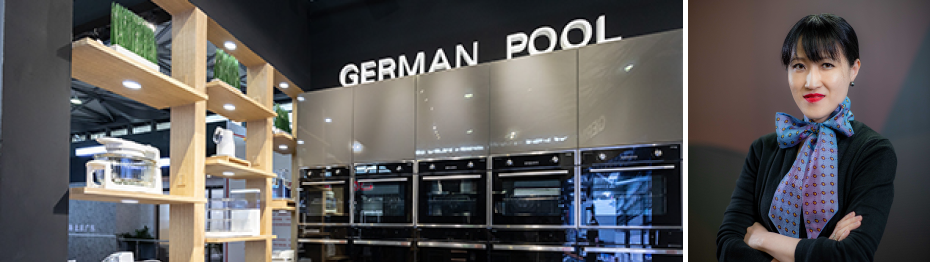
German Pool - Continuous Learning and Strategy Review is the Key
Starting its business in Hong Kong 38 years ago, German Pool set up factories in Shunde in its early years. It sees Hong Kong and Macau as its major markets, while focusing on B2B business in the Mainland market. In 2018, the financial tsunami swept across the world and led to a global economic recession. However, this also created new opportunities for German Pool to tap the B2B market in the Mainland. German Pool Group Company Limited Executive Director Professor Karen Chan said, “Despite the ups and downs that we encountered when venturing into the retail market in China, we realise that only by continuous learning and strategy review can our brand stay evergreen.”
Due to the far-reaching impacts of the US subprime mortgage crisis in 2008, many companies which engaged in import and export trade in the Mainland experienced great operation difficulties. In view of this, the Mainland Government promoted domestic sales vigorously. Coupled with the subsidies provided by the HKSAR Government, German Pool rode on the momentum and enjoyed many benefits. “Thanks to the government funds, the cost of expanding domestic sales dropped. We have our own factories in the Mainland. We have a long-established reputation and goodwill. We no doubt should take the chance to have a try by participating in Mainland exhibitions.” She added that German Pool caught up with the rising living standard in the Mainland and thereby notched up a success in the B2B market with a diversified product portfolio of electrical appliances and gradually built the distribution network.
Online and Offline Marketing as A Two-pronged Approach
Nevertheless, the rapid growth of online sales market led to parallel trading activities that dealt a severe blow to German Pool’s offline distribution network, reflecting the dire urgency of setting up a directly-operated e-commerce platform. German Pool thereby adopted a two-pronged strategy. Prof Chan mentioned, “Benefitted from tax concessions, German Pool developed directly-operated online shops at various cross-border e-commerce platforms such as Tmall and JD.com in a bid to expand business in this field.” In recent years, the edges brought by tax concessions has been eroding. Prof Chan decided to develop local e-commerce market in Hong Kong and the Mainland instead. Moreover, the company has been developing its online-to-offline (O2O) business, in a hope to create a brand new O2O marketing model by attracting customers at digital platforms to make purchases from physical businesses.
“Customers’ impressions about our brand are something really important. The key to success lies in the way we exhibit our brands’ level. German Pool is not simply an enterprise, it is a brand,” Professor Chan expressed. She pointed out that marketing campaigns through e-commerce and new media platforms, as well as new technologies can effectively enhance the customers’ awareness of the brand, thereby enhancing the business performance of its offline distributors and directly-operated stores, which prioritise customers’ experience. Offline and Online marketing strategies can complement and combine with each other – this is the recipe for success under the new business model.

Professionals Bridging Foreign Investors and Chinese Market
Apart from Hong Kong enterprises, foreign companies have also been keen to explore the Chinese market. While Hong Kong has always been a stepping stone for foreign-invested ventures to enter into the mainland market, how should Hong Kong’s professionals who are familiar with the national conditions as well as the market needs of international enterprises play its middle-man role and develop professional business services in the mainland at the same time? Established in 1973,
Fung, Yu & Co. CPA Limited is an example of adopting proactive approaches. Its Managing Partner Philip Yu said, “Our company has long been providing our foreign clients with a wide variety of corporate services. For instance, we have assisted enterprises from Europe, especially French-speaking countries in making investments in Hong Kong and the mainland. We also helped them set up companies in Hong Kong and the Mainland, open bank accounts and provide aftercare services, such as advisory services on working permit, human resources management and cross-border taxation, as well as accounting and auditing services.” Many foreign companies which are eager to develop overseas would use Hong Kong as a pilot site, due to various competitive, flexible and trustworthy banking, legal and taxation systems in Hong Kong. “At present, around 70% of the foreign newcomers to the Mainland market would set up their first office with actual operation in the mainland, while what they set up in Hong Kong are mostly virtual offices,” he revealed.
Yu continued, “Most of our clients are middle-sized European enterprises, especially French fashion brands. Although European countries have a rich history of brand development, famous brands and good products, they are interested in Chinese market as the European market is sluggish. As for China, there is adequate capital, but few historic brands. Therefore, Hong Kong professionals can help connect the two parties, which is in fact where our business opportunities lie.” Starting as a small-sized company with one Hong Kong office, Fung, Yu & Co CPA Limited has now grown to be a business with six offices in Hong Kong, Guangzhou, Shanghai, Beijing, Paris and Luxembourg hiring some 90 employees. It has also been the first Hong Kong accounting firm which has a physical office in France.
Multilingual Experts on China
In the Mainland, the company has provided their foreign clients with entirely English-speaking consultation services. Foreign customers account for 80% of the firm’s client base. Mr Yu explained, “As a Hong Kong company, these are our core competencies in the Mainland. First, we are familiar with the conditions in Hong Kong and the Mainland. Second, we can explain the situation in China to foreigners in English. Third, foreigners tend to be confident about Hong Kong’s professionals – as we always provide them with resolutions which are in compliance with relevant laws and regulations.” Mr Yu also told us that the laws and regulations in the first-tier mainland cities are relatively sound and clear with relatively little influence from human factors. “In the past ten years, you could barely see situations of people ‘exploiting system loopholes’ and conducting ‘backdoor deals’ in those first-tier cities. The laws and regulations there have become increasingly fair and ‘transparent,’ which has made foreign-invested companies be more eager to make investments there,” Mr Yu expressed.
Yet, enterprises still have to walk on a path beset with difficulties after setting up an office there. He bluntly said, “For our clients who entered into the mainland market, 30% of them failed, 40% broke even and 30% succeeded.” In his opinion, many enterprises can only see loads of money-making opportunities when they look at China’s domestic sales market but have not realised the intense competition there. “The mainland market is complex. It has a long investment payback period, and you can hardly get a big return in a short time. In addition, the operation cost is surging there. Now, if you wish to set up an office in Shanghai, its cost may only be approximately 20% lower than that in Hong Kong,” he shared. Yu suggested that companies should first study the tax regulations as well as the local consumption patterns and culture of the mainland cities which they would like to enter, make the product and service positions clear and integrate into the local culture. The firm’s successful experience in tapping the Mainland market serves as a good example for companies engaged in other industries to look at.

HK Enterprises Hard to Enter Chinese E-Market
It is in fact difficult for traditional brands to overcome those hurdles regrading technology, online promotion, post-sale services and logistics to achieve success in e-commerce. As a result, e-commerce agencies which help Hong Kong companies operate their business in the mainland market have naturally emerged. Convey Digital Media, a company originally engaged in the rental of outdoor advertising spaces, also transformed itself to develop online marketing business four to five years ago. It has successfully helped many well-known Hong Kong brands become popular in the Mainland, connecting those brands with the young consumers there.
Convey Digital Media Executive Director Terrance Yue told us that Hong Kong companies, regardless of their sizes, all agree that they do not know where to start as for doing online marketing in the mainland. “Netizens in the two places have absolutely different internet cultures and ways of communication. Some Hong Kong companies once hired Hong Kong people to operate their Mainland e-commerce business for them, yet eventually found that Hong Kong people in fact do not know how to write texts in the Mainland style. While for other Hong Kong enterprises which commissioned Mainland agents to do online marketing for them, the two parties ended up having difficulties in communication due to their cultural differences,” Mr Yue explained.
Advise SMEs to Test the Water
In order to achieve a breakthrough of such situation, he set up an office in the mainland a few years ago and built an e-commerce marketing team in which members know the Hong Kong and the mainland cultures well.
Mr Yue gave us an example of his company, saying that his team has assisted a large-scale local cosmetic chain store in managing its WeChat official account and has successfully doubled its fan base from 180,000 people in merely a year. The chain has accumulated 420,000 fans to date. Convey Digital Media has also provided brands with different solutions including Baidu search optimisation, writing Xiaohongshu posts, and running the brands’ WeChat official accounts. It even has its own online shopping mall which sells Hong Kong products.
While there are a large number of e-commerce and social networking platforms in the mainland, which may be dazzling to the eyes of the Hong Kong companies,
Mr Yue advised that local businesses should first evaluate their competencies and popularity before choosing the channels which suit them the best in accordance with their business nature. He explained, “If you use the wrong channel, you might just be dumping loads of money into the sea.” According to his experience, as SMEs are unlike other famous brands which have a lot of resources, it is unrealistic for them to register an official account or launch an online store. What they should first do is to establish their reputation through other intermediary online platforms. He told us that once a SME asked him to help it set up an online shop in the mainland. “That company has no idea that opening an online shop can cost up to a few million dollars. So, I advised it to sell its products via our online shop to test clients’ response first before making such decision,” he shared.
Across the border are tremendous business opportunities. However, the Mainland market is extremely complex and volatile, coupled with cultural differences between the two places, there are lots of challenges for Hong Kong enterprises to overcome. Learning from a few entrepreneurs’ successful experience, Hong Kong enterprises must firstly evaluate their niche and positioning, target at the right market, then employ the best business model and marketing strategies. It is also important for them to understand and keep abreast of Mainland policies and regulations, so as to identify opportunities at an early stage and utilise government support, as well as to avoid unnecessary misunderstanding and losses. Adapting to changes flexibly and timely is the key to success. Isn’t this what Hong Kong enterprises are always good at?
